
 EN
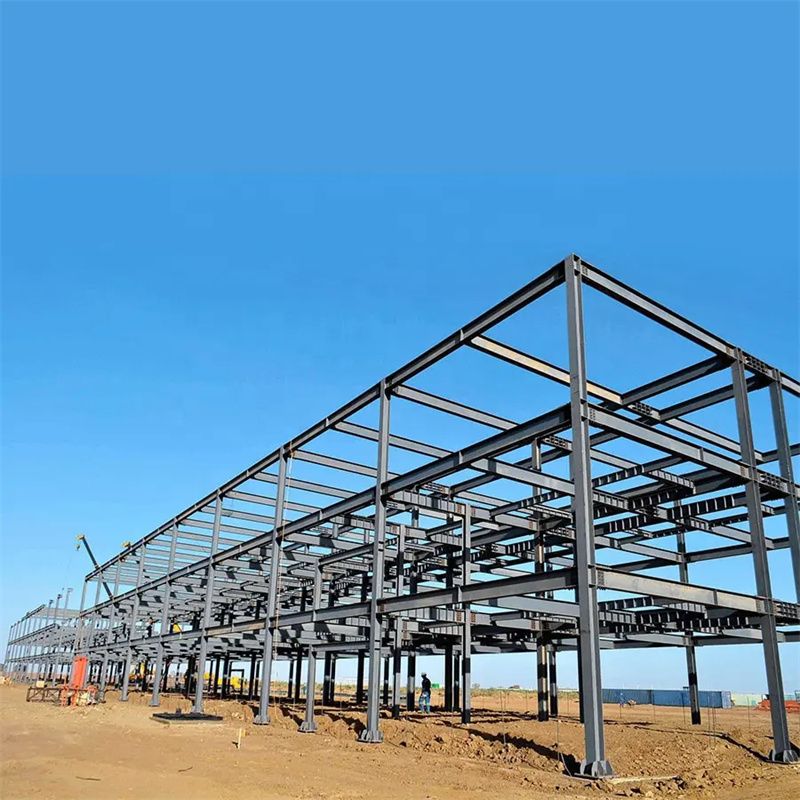
Superior Structural Performance of Steel in Industrial Environments
High strength-to-weight ratio and ductility: enabling large clear spans and heavy-load support
Steel delivers an unmatched strength-to-weight ratio—typically four to six times greater than reinforced concrete—making it ideal for industrial workshops requiring vast, column-free floor space. Clear spans of 40 m or more are routinely achieved, optimizing layout flexibility and simplifying the integration of heavy manufacturing equipment. This efficiency reduces overall dead load, shrinking foundation requirements and lowering construction costs. Equally important is steel’s high ductility: under tensile stress, it deforms significantly before failure. In practice, this allows a steel-framed bay to absorb the transient impact of an overhead crane lifting a 50-tonne component without permanent deformation. As confirmed by the World Steel Association (2023), properly proportioned steel members reliably support concentrated loads that would demand substantially heavier concrete sections—while permitting slimmer, less obtrusive columns that improve internal logistics and workflow.
Resilience to dynamic loads — cranes, machinery vibrations, and repetitive operational stresses
Industrial facilities subject structures to cyclic forces from bridge cranes, stamping presses, and rotating equipment—making fatigue resistance essential. Steel’s metallurgical microstructure provides a well-defined fatigue limit; when stress ranges remain below this threshold, connections can endure virtually infinite load cycles. Laboratory testing by the Steel Construction Institute (2021) shows that standard fillet-welded and bolted joints sustain over 5 million load reversals without crack initiation—outperforming many concrete and composite alternatives. Ductility further enhances resilience: during high-energy events like a snagged crane hook, steel frames dissipate shock through controlled plastic deformation rather than brittle failure. Modern detailing—including pre-loaded friction-grip bolts and shop-welded continuity plates—reinforces this behavior. The result is minimal vibration amplification and consistent alignment of precision production machinery across decades of intensive operation.
Accelerated Construction Timelines with Prefabricated Steel Structures
Prefabrication shifts critical work off-site, compressing schedules, reducing labor dependency, and eliminating weather-related delays. Steel structure solutions leverage this advantage at every stage.
Pre-engineered steel buildings: 40–60% faster erection versus traditional concrete methods
Pre-engineered steel buildings (PEBs) are designed and fabricated to exact specifications, enabling on-site assembly that is 40–60% faster than cast-in-place concrete. Concurrent workflows drive this acceleration: foundations are poured while components are manufactured in climate-controlled factories. One automotive parts manufacturer reduced its main structural timeline from six months to three using PEBs. Factory fabrication ensures near-perfect dimensional accuracy and eliminates weather exposure—achieving 98% schedule adherence versus just 63% for open-air sites. According to the Construction Industry Institute (2023), traditional projects lose 15–20 days annually to adverse weather alone. Pre-cut, pre-welded members arrive ready for bolted connections, cutting on-site labor hours by 40–60%. A 5,000 m² facility can be delivered in 16–30 weeks—a 55% reduction versus the 36–72 weeks typical for conventional builds. These efficiencies explain why 78% of commercial developers select prefabricated steel for time-sensitive projects.
Modular steel framing and cold-formed steel systems for streamlined offsite fabrication
Modular framing and cold-formed steel (CFS) extend prefabrication to full wall panels, trusses, and floor cassettes—manufactured under strict quality control. This precision slashes on-site assembly time: warehouses using pre-engineered components require 30% fewer on-site labor days than conventionally framed structures. Packaged kits eliminate procurement delays, and design approval cycles shrink from eight to three weeks. A leading e-commerce company erected 20,000 m² of sorting center space in just six weeks using modular steel units. CFS’s light weight reduces crane mobilization needs and speeds handling, while its dimensional consistency minimizes field adjustments. Just-in-time delivery enables parallel trades and reduces site congestion. Overall, modular and cold-formed systems shorten build cycles by 20–40% compared to traditional steel framing—making them ideal for fast-track industrial and logistics facilities.
Lifecycle Cost Efficiency of Steel Structure in Industrial Applications
Balancing upfront investment with long-term ROI: adaptability, low maintenance, and deconstruction value
While steel may carry a comparable or marginally higher initial material cost than concrete, its total cost of ownership is consistently lower over time. Adaptability is foundational: wide clear spans and modular bolted connections allow operators to reconfigure production lines or expand floor plates without demolition—cutting future capital expenditure and minimizing operational downtime. Maintenance demands are minimal: properly coated steel requires only periodic visual inspections and occasional bolt replacement, keeping annual upkeep below 1% of the original build cost. By contrast, concrete suffers from cracking, rebar corrosion, and spalling—triggering unpredictable repairs and production interruptions. Industry Lifecycle Data (2023) shows many steel industrial buildings exceed 50 years of service life. End-of-life value adds further economic benefit: steel is 100% recyclable, with dismantled beams, columns, and purlins retaining meaningful scrap or resale value. Concrete demolition, meanwhile, generates inert landfill waste and incurs disposal fees. When modeled over 30 years, total ownership cost for steel typically undercuts concrete alternatives by 15–25%—a compelling lifecycle rationale for developers prioritizing long-term asset performance.
Fire Safety, Sustainability, and Modern Mitigation in Steel Structure Design
Steel is inherently non-combustible—but its load-bearing capacity declines sharply above 550°C (European Committee for Standardization, 2023). Modern design counters this through integrated passive fire protection: intumescent coatings swell into insulating char layers, while fire-rated board encasements preserve structural integrity and extend safe evacuation time. On sustainability, steel’s closed-loop recyclability stands out: global recovery rates hover near 90%, and new structural sections routinely contain at least 25% recycled content—without compromising mechanical performance (World Steel Association, 2023). This significantly lowers embodied carbon and supports LEED, BREEAM, and other green building certifications. Beyond material-level strategies, holistic fire safety combines active suppression—such as automatic sprinklers or water-mist systems—with compartmentation and performance-based fire engineering to manage heat and smoke movement. Together, these layered approaches confirm steel as a resilient, resource-efficient choice for modern industrial workshops.
FAQ
Why is steel preferred over concrete for industrial workshops?
Steel is preferred for its superior strength-to-weight ratio, ductility, adaptability, faster construction timelines, and lower lifecycle costs compared to concrete.
What is a pre-engineered steel building (PEB)?
A pre-engineered steel building is a prefabricated structure designed to exact specifications, enabling faster on-site assembly compared to traditional construction methods.
How does steel ensure resilience to dynamic loads?
Steel's high fatigue limit and ductility allow it to endure cyclic and high-energy impacts, making it ideal for industrial environments with heavy machinery and cranes.
Is steel eco-friendly?
Yes, steel is 100% recyclable, has high recovery rates, and typically contains recycled content, making it a sustainable choice for industrial construction.
How does steel perform in fire scenarios?
Steel is non-combustible, and modern designs utilize intumescent coatings and fire-rated encasements to preserve structural integrity during fires.