
 EN
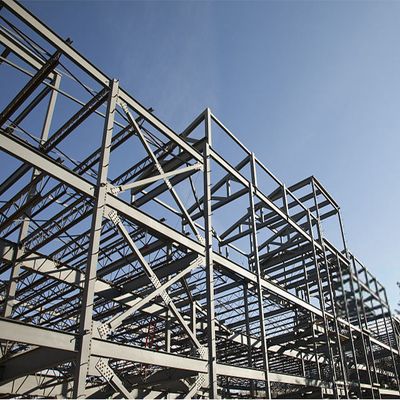
Structural Performance: Strength, Stiffness, and Fatigue Resistance
Yield Strength and Joint Rigidity Under Static Loads
In steel construction, the choice between bolted and welded ball space frame systems directly influences yield strength and joint rigidity under static loads. A welded ball node forms a full-penetration, monolithic connection that transfers forces continuously through the hollow sphere and tube wall—eliminating slippage and achieving joint yield capacity near that of the weaker connected member. This makes welded systems ideal for heavy gravity loads or long-span roofs where deflection control is critical.
By contrast, a bolted ball joint relies on a threaded stud and sleeve assembly preloaded to maintain bearing contact between the tube end and node. While effective, small manufacturing clearances and thread deformation can permit micro-slip before full load engagement. As a result, joint stiffness is typically lower than its welded counterpart, and yield capacity is governed by bolt shear, cone pull-out, or local bearing—not the tube’s cross-sectional strength. That said, this reduced rigidity remains acceptable for lightweight roofs and temporary structures when designers account for slightly larger deflections and apply non-linear joint modeling.
Fatigue Behavior in Cyclic Loading Conditions
Fatigue performance diverges significantly between the two systems. Welded ball nodes concentrate stress at the weld toe—a zone vulnerable to residual tensile stresses, undercut, porosity, or incomplete fusion—making it a natural site for crack initiation under repeated wind, crane, or seismic loading. Even with full-penetration welds and post-weld treatments, fatigue life is often dictated by the as-welded detail category per AISC 360-22 and AWS D1.1 (2020), requiring rigorous inspection and fatigue-sensitive detailing.
Bolted ball nodes avoid weld-related defects but introduce stress concentrations at thread roots and the cone seat. Proper preload in high-strength bolts reduces the cyclic stress range experienced by the bolt itself, since clamping force carries part of the fluctuating load. However, if preload relaxes due to vibration or thermal cycling, fretting wear and accelerated fatigue damage may occur. For high-cycle applications—such as large-span roofs in windy regions—bolted systems can offer more predictable fatigue life if torque audits and anti-loosening measures (e.g., Nord-Lock washers, thread-locking compounds) are rigorously maintained.
Fabrication and Erection Efficiency in Steel Construction
In steel construction, the relationship between fabrication precision and erection speed fundamentally shapes project delivery.
Shop Fabrication Precision and Tolerance Requirements
Bolted ball space frames demand tight dimensional control: CNC beam lines must hold bolt hole positions within ±1/32 in., per AISC 303-22 tolerances for standard structural steel. Deviations risk field reaming, shimming, or rejection—especially problematic given tolerance stack-up across multiple chord and web members, where a 1 mm error at one hole can compound into several millimeters at the opposite face.
Welded ball systems rely less on drilled hole alignment and more on jig-based fit-up, root gap control, and weld shrinkage compensation. Poor preheat practices or improper welding sequence can distort node angles—an issue difficult to correct post-welding. Shop inspection for welded joints typically requires ultrasonic testing per AWS D1.1 (2020); bolted joints need only dimensional verification. Consequently, bolted frames shift quality control upstream to cutting and drilling; welded frames concentrate it in welding procedure qualification and jig calibration. Leading fabricators mitigate cumulative error using part marking, trial assembly, and digital metrology—reducing field corrections and crane idle time.
On-Site Assembly Speed, Modularity, and Weather Resilience
Bolted ball space frames excel in modularity and weather resilience: pre-finished nodes and tubes arrive ready for direct bolting, eliminating hot work and enabling rapid assembly across the deck—even in wind, light rain, or cold temperatures. Field tightening takes minutes per node with calibrated torque wrenches, and no curing time is required. Modular installation also supports parallel workflows—one crew torquing nodes while another sets diagonals.
Welded ball systems require certified welders, temporary tacking, strict interpass temperature control, and post-weld inspection—all of which extend cycle time and increase weather exposure. A comparable welded node may take hours from preheat to cooling, followed by coating touch-up. Field welding further serializes tasks around individual joints, limiting concurrency. While bolted connections demand systematic torque verification—missed sequences can reduce stiffness—welded joints deliver monolithic continuity without loose hardware. For schedule-sensitive projects, especially on remote or congested sites, bolted modular erection can shorten the critical path and reduce crane dependency.
Lifecycle Economics: Maintenance, Inspection, and Long-Term Reliability
Corrosion Management, Bolt Re-Torque Protocols, and Joint Accessibility
The choice between bolted and welded ball space frames has lasting implications for lifecycle economics. Bolted joints support visual inspection, targeted bolt replacement, and periodic re-torque protocols—key for maintaining clamping force under cyclic wind or thermal loads. Yet each bolted interface creates a crevice prone to moisture and chloride entrapment, necessitating recurring sealant replacement and coating touch-ups. A 2021 benchmarking study across 40 industrial facilities found bolted space frames required re-torqueing every 3–5 years, adding roughly 4–7% to annual structural maintenance budgets.
Welded ball joints eliminate loose hardware and initial crevices, but hidden weld roots and sealed hollow interiors complicate corrosion detection and repair. Ultrasonic testing and boroscope inspection are essential—and often insufficient—for identifying internal degradation. According to NACE International, corrosion-related damage imposes a global cost of about $2.5 trillion annually (2016), underscoring the importance of inspection planning aligned with joint type. Accessibility differs markedly: bolted nodes allow localized disassembly for coating renewal, whereas welded structures frequently require full-member replacement to address concealed deterioration. Ultimately, long-term reliability depends not on initial cost alone, but on aligning inspection access, re-torque discipline, and coating maintenance strategy with the selected joint system.
FAQs
What are the main differences between bolted and welded ball space frames?
Bolted ball frames involve threaded stud and sleeve assemblies, enabling modular construction and faster erection. Welded ball connections form monolithic joints with higher stiffness and strength but require more labor-intensive fabrication and assembly steps.
Which system is better for fatigue resistance?
Bolted systems can offer more predictable fatigue life if bolt preloading and maintenance (e.g., torque audits) are well-managed. Welded systems, while structurally robust, are more prone to fatigue crack initiation due to stress concentrations at the weld toe.
How do bolted and welded systems compare in lifecycle maintenance?
Bolted systems allow easier inspection, targeted bolt replacement, and re-torque protocols, but require regular sealant and coating maintenance. Welded systems eliminate loose hardware but require complex inspection techniques for concealed corrosion, often resulting in higher repair costs.
Which system is faster to erect on-site?
Bolted systems are quicker to assemble due to modular, pre-finished components and a lack of curing time or hot work requirements, making them ideal for schedule-sensitive projects.
How does fabrication precision differ between the two systems?
Bolted systems demand high precision in CNC drilling, while welded systems rely more on jig-based assembly and welding quality, shifting the focus of quality control accordingly.