 EN
EN
High-Altitude Bulk Method for Steel Structure Trusses: Detailed Classification, Processes, and Practical Considerations
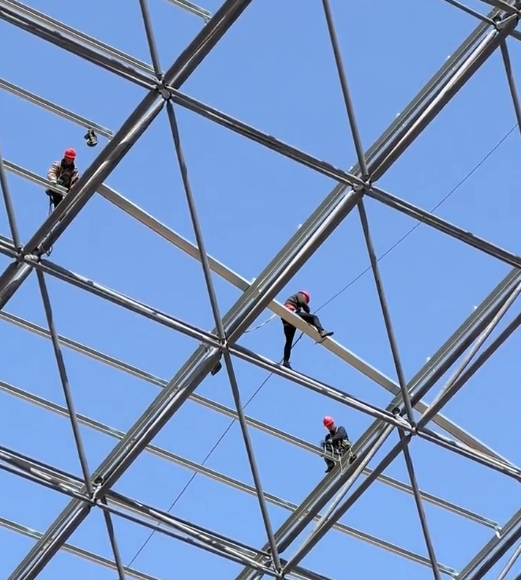
The high-altitude bulk method stands as a widely used installation technique for steel structure trusses, particularly valued for its flexibility in adapting to diverse structural forms and site conditions. Unlike integral hoisting or modular assembly methods that rely on large-scale prefabrication, this approach involves assembling truss components directly at the design elevation, making it a go-to choice for projects where ground space is limited or truss geometries are too complex for whole-unit handling. It is primarily categorized into two subtypes—full support method and partial support method—each tailored to specific truss sizes, complexities, and construction requirements, with distinct processes and operational nuances.
1. Full Support Method: For Small, Dispersed, and Complex Truss Structures
The full support method is specifically designed for small-scale steel truss structures, as well as those with dispersed components or intricate node connections (such as irregular trusses with non-uniform member spacing or custom-shaped nodes). Its defining feature is the use of a comprehensive temporary support system that covers the entire truss installation area, providing stable platforms for both workers and components throughout the assembly process. This system eliminates the risk of component displacement during installation and ensures precise alignment, making it ideal for trusses where even minor deviations could compromise structural integrity.
The construction process of the full support method unfolds in four key steps. First, preparation and component prefabrication take place on the ground. Workers fabricate small truss components (including steel beams, rods, and connecting nodes) according to detailed design drawings, ensuring each part meets dimensional tolerances—common practices include using CNC cutting machines for steel plates and welding robots for node connections to guarantee consistency. Every component is then labeled with a unique identification number, corresponding to its position in the truss assembly diagram, to avoid confusion during high-altitude handling.
Second, the temporary support system is erected. This system typically consists of steel scaffolding or adjustable steel props, installed in a grid pattern that aligns with the truss’s node positions. The height of the supports is calibrated to match the truss’s design elevation, with levelness checked using laser levels to ensure no more than ±2mm of deviation per meter—this precision is critical, as uneven supports can lead to truss deformation during assembly. Additionally, the support system’s load-bearing capacity is calculated to withstand not only the weight of the truss components but also the weight of workers, tools, and any temporary materials (such as welding equipment or spare bolts).
Third, component hoisting and on-site assembly begin. Small cranes or hoists lift the prefabricated, numbered components to the high-altitude support platform one by one. Workers then assemble the components in the sequence specified by the design—usually starting from the truss’s fixed ends (connected to the building’s main structure) and progressing toward the free ends. Node connections are secured using high-strength bolts or welding, with torque wrenches used to verify bolt tightness (meeting industry standards like AISC or EN 1993) and ultrasonic testing to check weld quality. Throughout the process, theodolites are used to monitor the truss’s horizontal and vertical alignment, with real-time adjustments made if components shift out of place.
Finally, after the entire truss is assembled, the support system is dismantled incrementally. Dismantling starts from the truss’s midpoint or free ends and moves toward the fixed ends, ensuring the truss remains supported at critical points until the last section of the support is removed. A final inspection is conducted to confirm the truss’s overall stability, with measurements taken to verify that deflection (vertical displacement under self-weight) stays within design limits.
2. Partial Support Method: For Large, Multi-Component Truss Structures
In contrast to the full support method, the partial support method is engineered for large-scale steel trusses with numerous components—such as long-span roof trusses for industrial warehouses or airport terminals—where a full support system would be excessively costly, time-consuming, or impractical (e.g., when the truss spans over existing buildings or infrastructure). This method uses a limited number of temporary supports, focusing on key load-bearing points of the truss, and leverages pre-assembled small units to streamline high-altitude work.
The process of the partial support method is structured around two core phases: ground pre-assembly of small units and high-altitude extension assembly. In the first phase, workers on the ground assemble individual truss components into stable, self-supporting small units (each weighing 1–3 tons, depending on hoisting capacity). These units typically consist of 3–5 truss members connected at nodes, forming a rigid section that can be lifted without deformation. Each unit is labeled with its installation position and orientation, and a trial fit is conducted to ensure adjacent units can be seamlessly joined—this reduces the risk of on-site rework, which is far more difficult at high altitudes.
Next, temporary partial supports are installed. Unlike the full support system, only 3–5 key supports are placed along the truss’s length, usually at locations where the truss experiences the highest bending moments (as calculated by structural analysis software like SAP2000 or ETABS). These supports are often heavier-duty than those used in the full support method, with reinforced bases to handle larger loads, and their height is calibrated to ensure the truss units sit at the correct elevation.
The third step involves hoisting and extending the small units. A medium-tonnage crane (10–20 tons) lifts the pre-assembled small units to the high-altitude supports. The first unit is fixed to the building’s main structure (e.g., a concrete column or steel beam) and secured to the nearest partial support. Subsequent units are then lifted and connected to the already installed unit, using bolted or welded joints—workers use alignment pins to ensure the units fit together precisely before final fastening. This "extension" process continues until the entire truss is assembled, with each new unit providing additional stability to the growing structure.
Like the full support method, the partial support system is dismantled gradually after assembly, with the truss’s deflection monitored during dismantling to ensure no sudden stress changes occur.
Advantages and Limitations of the High-Altitude Bulk Method
The high-altitude bulk method offers two key advantages that make it a preferred option for many truss projects. First, its construction process is simple and cost-effective: it eliminates the need for large-scale prefabrication yards or heavy lifting equipment (such as crawler cranes for integral hoisting), reducing both equipment rental costs and site preparation time. Second, it saves materials: temporary supports (especially in the partial support method) use far less steel than full-scale assembly platforms, aligning with sustainable construction practices.
However, the method also has notable limitations. It is highly sensitive to truss design parameters: factors like truss span (spans over 30 meters may require additional supports), column grid size (irregular column spacing can complicate support placement), and deflection (long trusses may sag excessively during assembly) can all impact its feasibility. Additionally, it relies heavily on outdoor operations, making it vulnerable to weather conditions—rain, strong winds (over 5 m/s), or extreme temperatures can delay work and increase safety risks. Finally, it requires a relatively large construction site for ground prefabrication of components or small units, which may be a constraint in dense urban areas where space is at a premium.
In summary, the high-altitude bulk method—through its full support and partial support subtypes—provides a versatile solution for steel structure truss installation. By matching the method to the truss’s size, complexity, and site conditions, construction teams can balance efficiency, cost, and safety, ensuring successful truss assembly that meets structural performance requirements.